
LNG Makes Canada Stronger..For Who Exactly?
Billboards don’t usually capture my attention unless they’re culture jamming or calling for stronger environmental protections. Most are a forgettable blur of business advertisements ranging from luxury real estate to fast food restaurants.
So, I did a double-take on a recent drive through Port Alberni as I spotted a billboard declaring “LNG Makes Canada Stronger”. While many jurisdictions around the world have banned fossil fuel advertisements, there’s no such luck here in British Columbia.
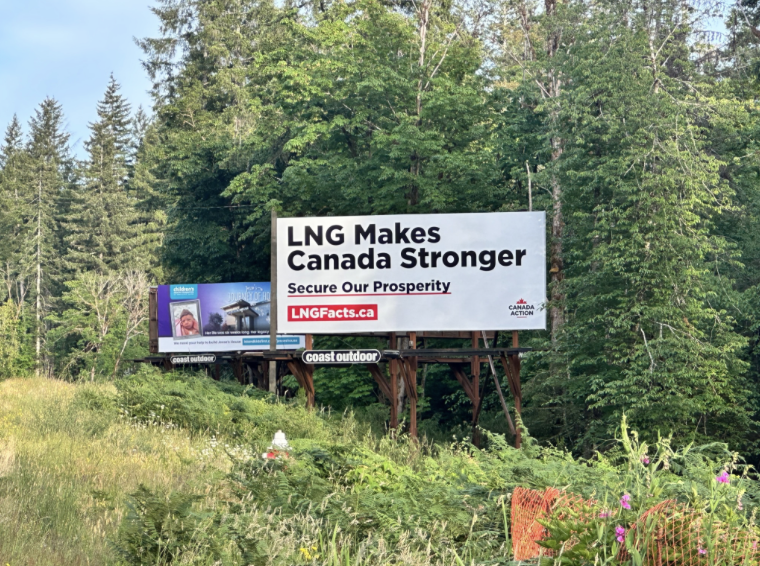
Canada Action billboard outside of Port Alberni
Canada Action, the organization behind the sign, advocates for the expansion of Canada’s natural resource sector, including LNG. No need to hold your breath on who funds Canada Action, either (spoiler alert: includes oil and gas). In light of the claim “secure our prosperity”, who actually benefits from LNG?
LNG stands for liquified natural gas, which is mostly methane, a pernicious greenhouse gas that traps far more heat in the atmosphere than carbon dioxide over the short term. While the fossil fuel industry promotes LNG as a cleaner alternative to other fossil fuels, a growing body of research debunks this idea. In fact, the full life cycle of LNG, from extraction to processing to transportation, makes its overall footprint worse than that of coal.
The concerns of LNG do not end with climate pollution. Across North America, communities living near fracking operations, gas infrastructure, and export terminals have raised concerns about impacts on air quality, water quality, public health, and safety, including a history of fires and explosions at terminal sites. The Narhwal outlines these issues with LNG Canada: “the country’s first large-scale LNG export facility, might have flared more gas than any other plant on earth last year” in Kitimat, BC, leaving residents exhausted and increasingly concerned about health effects. As a Kitimat resident shared: “At 2:45, my backyard was covered in grey smoke when I was cooking hot dogs. You get this smell for a few seconds. It smells like burnt plastic or burnt Styrofoam.” Many LNG projects in Canada also generate significant concerns regarding Indigenous rights, title and consent. The ongoing resistance of the Wet’suwet’en Nation’s hereditary leadership to the Coastal GasLink pipeline remains one of the most visible examples.
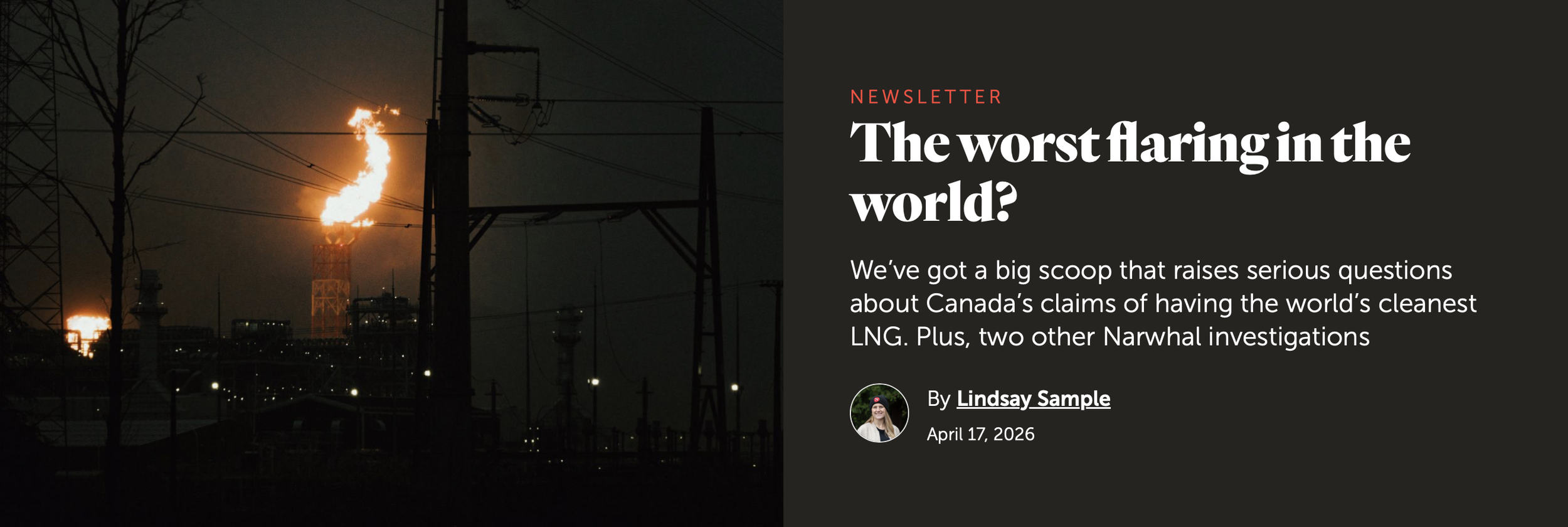
From The Narwhal
There’s also growing unease about the financial risks associated with LNG expansion. Despite the uncertainty surrounding global LNG markets, public institutions such as Export Development Canada continue to support new LNG projects. For instance, while the Western LNG Ksi Lisims project in Kitimat, BC, is owned by American billionaires, the federal government still plans to subsidize it with our tax dollars. We can make our voices heard to urge our government not to use our public funds for LNG. Recent conflict in the Middle East has led some proponents to argue that higher global gas prices strengthen the case for new LNG development. However, analysts note that these price increases are largely driven by geopolitical instability and market volatility rather than long-term shifts in demand. While conflicts can create temporary price spikes, they do not necessarily improve the long-term economics of projects that take years to build and decades to recover their costs. In fact, some analysts warn that energy shocks often accelerate investment in renewable energy, energy efficiency, and domestic energy security, potentially reducing future demand for LNG.
These concerns are reinforced by the history of LNG projects in Asia and elsewhere that have been delayed, cancelled, or scaled back due to changing market conditions, cost overruns, and weaker-than-expected financial returns. As renewable energy costs continue to fall and countries around the world invest in clean technology and low-carbon industries, many question whether pouring public money into new LNG infrastructure represents an investment in Canada’s future or a subsidy for yesterday’s economy. Rather than doubling down on industries whose long-term prospects are increasingly uncertain, Canada has an opportunity to invest in a more diverse, innovative, and sustainable economy that creates resilient jobs and prosperity for generations to come. We can make our voices heard to urge our government not to use our public funds for LNG
These issues all intersect to lead to a larger question: what kind of future are we building? And for whom? While scientists are sounding the alarm about an accelerating climate crisis, Canada is seriously considering a major expansion of fossil fuel infrastructure across the country. Yet the impacts of the climate crisis are already being felt across coastlines and oceans through warming waters, ocean acidification, sea level rise, increasing severity of storms, and impacts to biodiversity.
I’m fortunate not to live beside a polluting LNG facility or any other fossil fuel development, unlike many of my fellow residents in BC. With my home base on the west coast of Vancouver Island, the closest proposed LNG project to me is FortisBC’s Tilbury LNG facility expansion. This project is set to take place along a fragile part of the Fraser River in Delta, BC. If approved, it would bring 136 tanker voyages every year in the Salish Sea, adding to the growing industrial pressures on waters that sustain salmon, Southern Resident orcas, and many coastal communities. This project will also generate 100 million tonnes of greenhouse gas emissions every year, contributing to a consequential global climate impact felt most by the people and countries who have done the least to contribute to a warming planet.
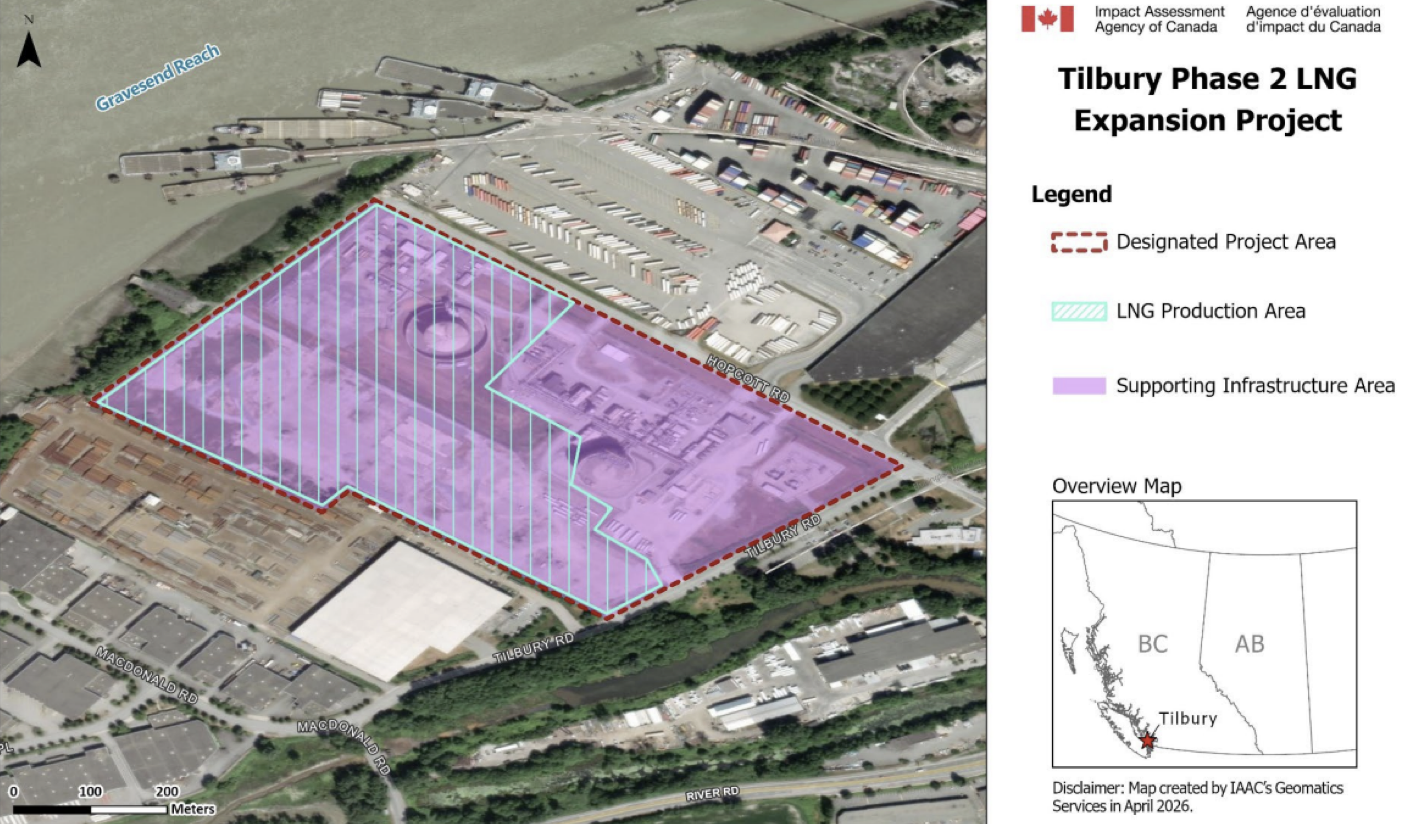
Tilbury LNG designated project area
While Canada is trying its hardest to double down on fossil fuel expansion, we can continue making our voices heard. The Tilbury LNG expansion is currently undergoing BC’s environmental assessment process, and the public comment period is open for us to share our feedback. The more people who speak up about the project’s impacts on climate, oceans and coastal communities, the more decision-makers will understand the level of public concern surrounding the proposal. We can sign Stand.earth’s petition calling on the BC and federal governments to reject the Tilbury LNG expansion plan, and provide feedback to the Government of BC until July 27, using Stand.Earth’s toolkit to make your submission easier!
We can also flood the federal government with our opposition to fast tracking extractive development projects in Canada, including LNG. After hearing from thousands of Canadians, the federal government announced it is extending consultations on proposed changes to Canada’s environmental laws from June 7 to July 22. More time creates a larger window of opportunity for us to make our voices heard, so public engagement remains critical in the weeks ahead! Take action and share this action here.
Canada has everything it needs to build a truly prosperous future for all people, powered by renewable energy and a circular economy. Public dollars should be invested in solutions that lower emissions, eradicate pollutants, create long term jobs, respect and uphold Indigenous rights, support thriving communities and protect and restore the ecosystems that sustain us. While we press for this better future, our activism can continue to serve as a toolbox for change in our local communities, creating favourable conditions for larger systemic transformation.